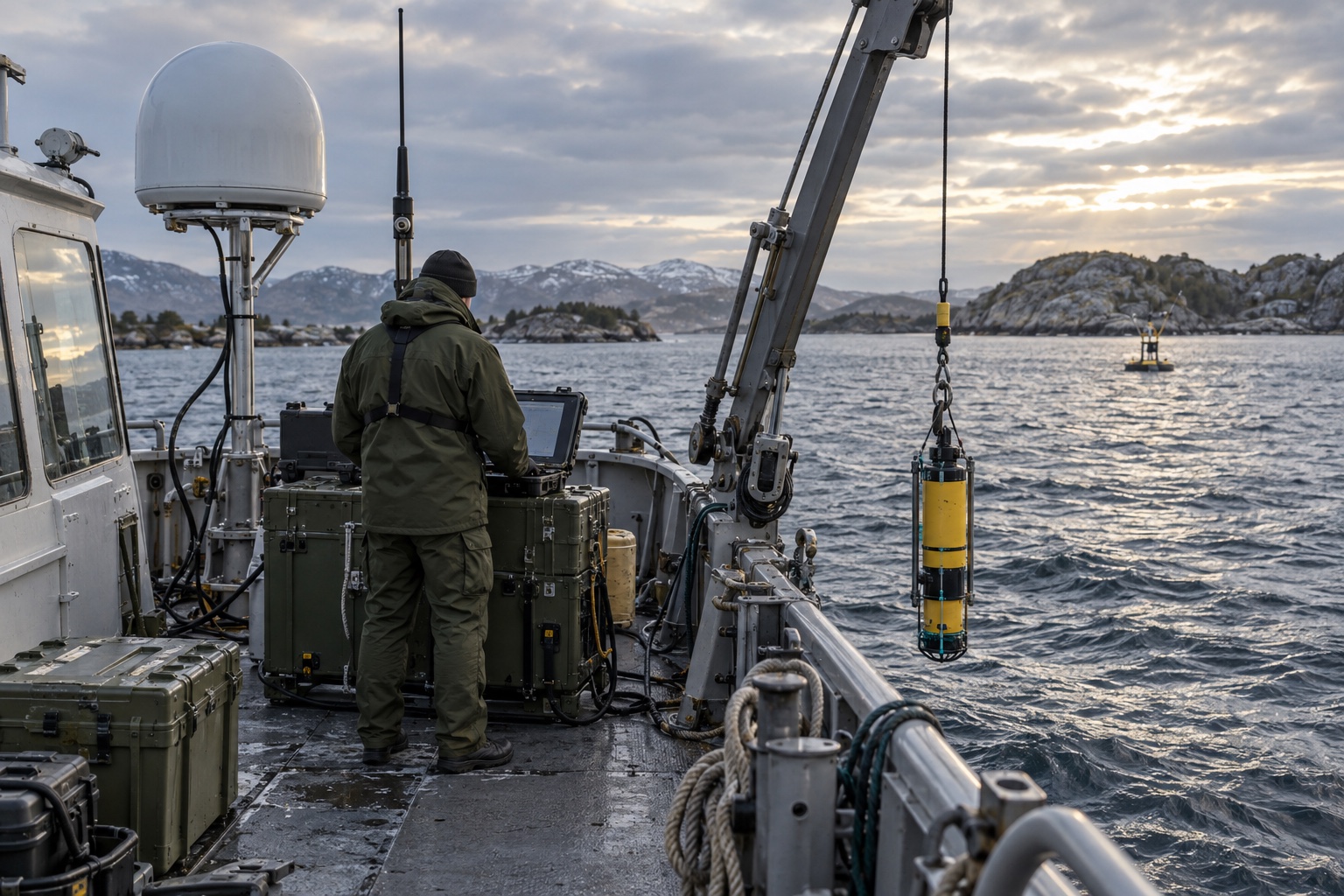
Connect subsea acoustic, satellite, radio and IP communications in one operational system. Varindor’s multi-bearer gateway relays endpoint-encrypted messages between different networks while preserving payload encryption through the gateway. We combine durable message delivery, link selection and operator tools around the constraints of your mission.
A submerged sensor, a surface vessel and a team ashore face different communications conditions. Bandwidth, delay, power and availability change along the route. Essential reports and alerts need to cross those boundaries, retain their protection and remain accounted for when a connection is interrupted.
What we bring together
From the available link to the intended recipient.
Encrypted message relay
Carry a message across different communications bearers without opening its encrypted content at the relay gateway. The sending application protects the payload and the receiving application opens it. Routing and delivery information let the gateway move the message while its content remains sealed.
Delivery through interruptions
Retain messages durably, retry eligible routes and keep track of delivery evidence. Routing policy can prioritise urgent traffic, select alternatives after a failed attempt or send critical messages over multiple eligible links. Message expiry and delivery requirements remain part of the decision.
Operator coordination
Bring text messaging, duress alerts, recorded voice and live calling into an operator workflow with visibility into connection and delivery state. Live calls use links that can support their media requirements. Application integrations can carry position reports and other mission data as encrypted messages.
Across communications domains
From seabed to shore. Protection travels with the message.
A representative route starts with an encrypted report from a subsea instrument. An acoustic link carries it to a surface gateway, which retains the message and forwards it over an eligible satellite or IP connection towards the shore application.
The relay can change the transport and its link protection while keeping the application payload encrypted. Equipment, routes and delivery policy are configured for the deployment, including what happens while the onward connection is unavailable.
01 · Acoustic link
Subsea endpoint
The application encrypts its report before transmission.
02 · Satellite or IP link
Surface gateway
Retain, select a route and forward the sealed payload.
03 · Application delivery
Shore endpoint
The receiving application opens the message with its key.
Illustrative message route. Each link must meet the message’s size, timing, security and delivery requirements.
Communications bearers
Different media. Explicit operating constraints.
A bearer is the communications link that carries a message. Our existing implementations cover acoustic modems, Iridium short-burst satellite messaging, LoRa radio and IP transport. Further RF and optical satellite equipment can be addressed through scoped integrations.
Bearer capabilities and the constraints that shape delivery
Bearer
Capability
What shapes delivery
Subsea acoustic
Addressed acoustic modem messaging, protected link frames and acknowledgement of custody by the receiving gateway.
Limited capacity, propagation delay, half-duplex operation and modem availability.
Satellite · Iridium SBD
Short-burst messaging through modem and ground-side connections, with message segmentation and reassembly.
Small transmission sizes, signal availability, session time, delivery evidence and spending limits.
Radio · LoRa
Point-to-point radio messaging with configurable modulation, fragmentation and receiving-gateway acknowledgements.
Airtime, duty-cycle budgets, packet size and half-duplex operation.
IP networks
Protected TCP and UDP transport for messages and live media over suitable IP connectivity.
Reachability, capacity, delay, loss and the requirements of the message or call.
Further RF & RF satelliteEquipment integration
Integration of additional radio and satellite equipment with the common gateway and routing policy.
Equipment interfaces, link characteristics, available bandwidth and timing constraints.
Optical satelliteEquipment integration
Integration support for optical links, with feasibility inputs informing whether a link is available.
Line of sight, pointing and tracking, atmospheric conditions and availability windows.
Transport support and application requirements are evaluated together. A link suitable for a short report may not be suitable for a live call.
Built to be composed
Communications connected to the operational picture.
We have built the gateway and operator terminal alongside capabilities for planning, situational understanding and physical analysis.
For a customer deployment, we can connect the relevant equipment and applications, configure priorities and routing policy, and shape the operator workflow around the mission. Link selection can weigh capacity, delay, loss, confidence, energy and cost while respecting the requirements of each message.
Our broader analytical capabilities can help examine the communications environment and its consequences for the plan.
Compare available bearers against message size, deadline, protection and acknowledgement requirements. Examine why a route is eligible, why another is refused and how the choice changes when capacity or cost changes.
What happens when a link disappears?
Follow retained messages through interruption and recovery. Examine alternate routes, expiry, duplicate handling and the evidence that distinguishes a transmission attempt from delivery at the required point.
What should take priority?
Put routine reporting, larger transfers and urgent alerts into the same representative scenario. Review which traffic moves first, when multiple links should carry an alert and what operators can see about the outcome.
Explore the fit
Bring the route your mission depends on.
Describe the endpoints, available equipment and information that must move between them. Include the interruptions, delays and delivery requirements that matter to your operation. An unclassified or representative scenario is enough to begin.
We can demonstrate the relevant gateway and operator capabilities, identify the integration work and define a focused evaluation around your communications problem.